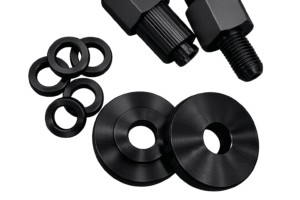


Custom-Made Parts for Yacht, Sailing Boat and Rowing Boat Masts & Rigging
A mast under sail is rarely at rest. Halyards run through blocks, sheets load and unload with every gust, and standing rigging remains under changing tension as the boat moves through the water. Small fittings such as cleats, tangs, spreaders, gooseneck fittings, blocks, and turnbuckles must handle repeated loads while exposed to salt spray, humidity, UV, and constant outdoor use.

That is why custom-made rigging hardware needs more than accurate dimensions. It must withstand rope friction, resist corrosion, and maintain reliable performance over time. Achieving this starts with the right material and continues through precision machining, inspection, polishing, surface treatment, and final fitting. This article follows that process from raw material to finished marine component.
Raw Material Procurement: Authentic Materials Start with Traceability
Every custom rigging component begins with the right raw material. Using certified stainless steel, bronze, aluminium, or other suitable alloys helps ensure that the finished part has the strength, corrosion resistance, and wear resistance required for its intended marine application.
Material selection should consider:
- Corrosion resistance: Important for components exposed to saltwater, spray, and humidity. Marine-grade stainless steels such as 316 are commonly selected for their improved resistance to chloride environments, although localised corrosion can still occur under certain conditions [1].
- Strength: Essential for load-bearing parts such as tangs, chainplates, and turnbuckle components exposed to repeated loading.
- Wear resistance: Important for fittings that experience continuous contact with ropes, pins, or other moving parts.
- Application: Material requirements vary depending on whether the component is used above deck, in a splash zone, or in a more continuously wet environment.
Incoming material can also be verified through spectroscopic testing, including optical emission spectroscopy (OES) or X-ray fluorescence (XRF). These methods analyse the material's elemental composition and help confirm that it matches the specified grade.
Once verified, each material batch can be recorded and traced through production. This provides greater control over the manufacturing process and helps ensure that the material specified for the component is the material actually used.
CNC Machining: Precision Manufacturing for Complex Marine Parts
Once a material batch is verified, it moves to machining, where certified stock becomes the actual part. This is the stage that determines whether a fitting will sit flush against a mast track, whether a pin will pass through a clevis without play, and whether a block sheave will run true for years of use. The machining method is chosen based on the geometry of the part rather than applied as a single default process across every component.
- 3-axis CNC machining. The cutting tool moves along three linear axes, X, Y, and Z. This is well suited to flatter, simpler geometries such as brackets, plates, and general-purpose fittings where all the features can be reached from a limited number of angles.
- 4-axis CNC machining. A rotary axis is added, allowing the part to be machined from additional angles without being removed and re-fixtured. This improves efficiency on parts with features on more than one face, such as fittings with holes or slots set at an angle to the main body.
- 5-axis CNC machining. All axes can move together, letting the cutting tool stay correctly oriented to curved and compound surfaces throughout the cut. Every time a part is removed from a machine and re-fixtured, there is a risk of small positional shifts between features. Holding a part in a single setup avoids this, which is why 5-axis machining is generally reserved for complex geometries, curved surfaces, and components with tight true-position tolerances between multiple features, cases where re-fixturing error would otherwise stack up as the part moves through several setups [2].

Other available manufacturing processes may include:
- CNC turning: For pins, shafts, bushings, and cylindrical components.
- Grinding: For critical dimensions and surface finishes.
- Deep-hole drilling: For long and precise internal bores.
- Wire cutting and EDM: For intricate profiles and difficult-to-machine features.
- Stamping and bending: For suitable formed components.
- Welding: For fabricated parts and assemblies.
For marine hardware, machining accuracy directly affects how components fit and operate. Correct hole positions, clearances, bores, and mounting surfaces help ensure that fittings assemble properly and moving components operate as intended.
Quality Inspection: Verifying Every Critical Dimension
Machining produces the component, but inspection determines whether that component is actually fit for its intended use. For custom mast and rigging parts, this is especially important because the finished piece may need to match an existing fitting, connect with several other components, or operate under repeated loading for long periods. Inspection therefore focuses on more than whether a part looks correct. It verifies the dimensions, geometry, surface condition, and interfaces that determine how the component will perform.

Checking dimensions against the drawing
Every critical dimension should be checked against the approved drawing, model, sample, or technical specification. The inspection process may include:
- Overall dimensions: Length, width, thickness, diameter, and other basic measurements.
- Hole dimensions: Diameter, depth, spacing, and position of drilled or machined holes.
- Geometric accuracy: Flatness, perpendicularity, concentricity, parallelism, and other relevant characteristics.
- Tolerances: Confirmation that critical dimensions remain within the specified limits.
- Surface condition: Checking for machining marks, burrs, scratches, or other defects that could affect performance.
- Functional interfaces: Verification that the component will correctly connect with pins, shafts, fasteners, ropes, bearings, or mating parts.
Manufacturing research has shown that machining errors can arise from factors such as machine-tool accuracy, workpiece positioning, fixturing, and process setup. Inspection provides the feedback needed to identify these deviations and maintain conformity with the design requirements. [1][2]
For example, consider a custom clevis fitting with two aligned pin holes. The hole diameter may be correct, but if the centres are slightly misaligned, the pin can bind during assembly. Similarly, a sheave housing can have the correct external dimensions but still produce uneven operation if the bore is not correctly positioned relative to the surrounding geometry.
Inspection of functional interfaces
The most important measurement is not always the largest one. A small hole or narrow clearance can determine whether an entire assembly works correctly.
For marine components, particular attention may therefore be given to:
- Pin and bolt holes
- Bearing and bushing seats
- Sheave bores
- Threaded sections
- Mounting faces
- Rope-contact surfaces
- Connection points between moving components
A custom component should not only conform to its drawing. It should also perform its intended function when installed.
Consistency in custom and small-batch production
Inspection becomes even more important when producing small quantities. A customer may order only two or three replacement components, but those parts still need to match the required dimensions consistently.
A controlled inspection process helps prevent a situation where one part fits correctly while another requires adjustment during installation. For replacement hardware, this can save considerable time, particularly when the component is located in a difficult-to-access position such as a masthead fitting.
Once the critical dimensions and interfaces have been verified, attention can move to the component's surface. This is where polishing becomes particularly important for parts that work directly with ropes.
Polishing: Removing Sharp Edges to Protect Ropes
Polishing is often associated with the appearance of stainless-steel marine hardware, but its functional purpose can be just as important. A rope does not interact with a component only once. Halyards, sheets, control lines, and other ropes can pass through or over fittings repeatedly, making the condition of the contact surface an important part of the system.
A surface that appears smooth to the naked eye can still contain machining marks or rough areas capable of damaging fibre ropes during repeated movement. Research on fibre rope running over steel components has shown that surface roughness can cause significant abrasion and reduce the residual strength of the rope. [3]
Removing burrs and sharp edges
Machining can leave small burrs and sharp transitions around holes, slots, edges, and milled surfaces. These need to be removed before a component is put into service.
The finishing process can address:
- Sharp edges
- Machining burrs
- Rough corners
- Tool marks
- Uneven transitions
- Localised surface defects
The degree of finishing should depend on how the surface will be used. A concealed mounting surface does not necessarily require the same treatment as a fairlead, guide, sheave or fitting that remains in continuous contact with a moving rope.

Removing Sharp Edges to Protect Ropes
Reducing rope abrasion
The relationship between surface condition and rope wear is particularly important for synthetic lines. Research has found that even relatively small surface roughness on a steel contact element can initiate significant abrasion under cyclic loading. [3]
For example, a rope running repeatedly through a fitting with a rough internal edge can gradually lose fibres at the contact point. The damage may not be obvious during the first few uses, but repeated loading can progressively reduce the rope's strength.
A properly finished contact surface helps reduce this unnecessary abrasion. It does not eliminate rope wear altogether, since rope life also depends on factors such as material, loading, bending radius, moisture, contamination, and operating conditions. However, controlling the condition of the metal surface removes one avoidable source of damage.
Finishing for both function and appearance
For visible yacht hardware, polishing also improves the appearance of the finished component. More importantly, it creates a controlled surface suitable for the component's intended use.
This distinction matters. A highly polished exterior does not automatically mean that every functional surface has been finished correctly. Contact areas, internal edges, holes, and transitions should receive attention according to how the part will operate.
Once the surface has been prepared, the next stage is to protect the component against the environment in which it will spend its service life.
Surface Treatment: Additional Protection Against the Marine Environment
A marine component can be precisely machined and correctly finished, yet still deteriorate if its material and surface protection are not appropriate for the environment. Saltwater, humidity, salt deposits, temperature changes, and trapped moisture can all influence corrosion behaviour.
Stainless steel relies on a passive surface film for much of its corrosion resistance, but that protection can be disrupted under aggressive conditions. Research has demonstrated that seawater chemistry and environmental factors can influence the stability of this passive layer and the development of localised corrosion. [4]
Choosing treatment according to the material
Surface treatment should therefore be selected according to the base material and the conditions in which the component will operate.
Depending on the material and application, finishing and protection may involve:
- Mechanical polishing
- Passivation
- Protective coatings
- Surface conversion treatments
- Other material-specific finishing processes
The correct approach depends on the component rather than following a single treatment for every order.
For example, a stainless-steel deck fitting and an aluminium mounting component may both be used on the same boat, but they do not necessarily require the same surface treatment. Their alloy chemistry, corrosion mechanisms, hardness, and compatibility with surrounding materials are different.
Protection against saltwater and humidity
Marine corrosion is not limited to parts that are permanently submerged. Salt spray can settle on exposed surfaces, while humidity can keep those surfaces wet for extended periods.
Small gaps and enclosed areas can be particularly difficult because moisture and contaminants may remain trapped. These conditions can contribute to localised corrosion even when the majority of the surrounding surface appears unaffected.
This is one reason why surface treatment should be considered together with component design. Avoiding unnecessary crevices, maintaining suitable surface finishes, and selecting an appropriate material can all contribute to better corrosion performance.
Supporting long-term service
Surface treatment is not a substitute for correct material selection. Instead, it forms part of a broader protection strategy:
- Material selection provides the underlying corrosion resistance.
- Machining creates the required geometry and surface condition.
- Polishing improves functional contact surfaces.
- Surface treatment provides additional protection where required.
- Inspection verifies that the finished component meets its requirements.
This combined approach is more reliable than treating corrosion protection as something added only at the end of production.
Assembly and Fitting: Ensuring Components Work as Intended
For some custom marine parts, machining and finishing are not the final stages. Components may need to be assembled together or checked against mating parts before delivery. This provides an additional opportunity to verify that individual pieces function correctly as a complete system.

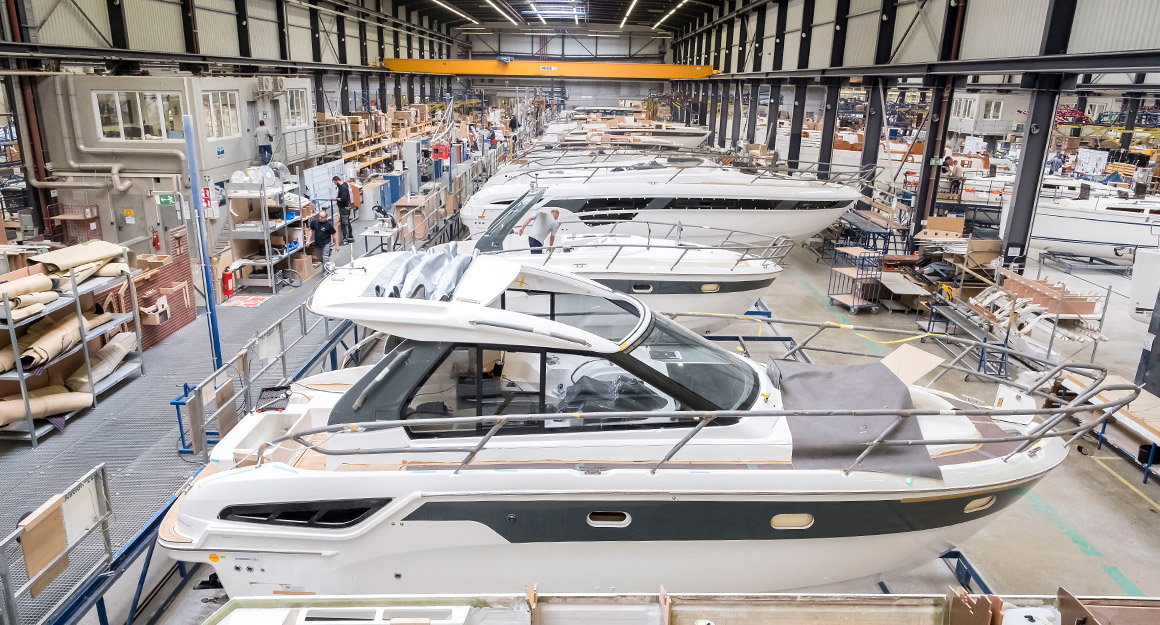
Boat building on the assembly line
A part can meet its dimensional specification and still perform poorly if it does not align correctly with the component it is designed to work with. Assembly inspection helps identify these problems before the parts reach the boat.
Checking fit and alignment
Depending on the component, assembly checks may include:
- Alignment between connected parts
- Correct positioning of holes and pins
- Clearance between moving components
- Fit of shafts, bushings, or bearings
- Thread engagement
- Contact between mating surfaces
- Freedom of movement
For example, a custom sheave assembly should allow the sheave to rotate freely without excessive lateral movement. A clevis fitting should accept its pin without forcing the components together. A mast connection should sit correctly against its mounting surface rather than relying on installation adjustments to compensate for manufacturing errors.
Final functional inspection
Where appropriate, the assembled component can be operated before delivery. This can include checking movement, alignment, rotation, or connection points.
This is particularly useful for complex custom orders because the customer receives a component that has already been checked as a working assembly rather than a collection of individually manufactured pieces.
For replacement parts, this can also make installation easier. Instead of discovering a dimensional mismatch after the component has been transported to the boat, the issue can be identified and corrected during production.
The completed component is now ready for the final evaluation: whether its material, geometry, finishing, and manufacturing quality provide the durability required for long-term marine use.
Built for Long-Term Use at Sea
The purpose of a controlled manufacturing process is not simply to produce a part that matches a drawing. The finished component needs to continue performing when exposed to the combination of movement, mechanical loading, moisture, salt, and repeated use found in a marine environment.
Three qualities are particularly important: wear resistance, corrosion resistance, and long-term reliability.

Wear resistance
Wear becomes a concern wherever two surfaces repeatedly move against one another. In mast and rigging systems, this can occur between:
- Rope and metal fittings
- Pins and holes
- Shafts and bushings
- Sheaves and axles
- Fasteners and mounting surfaces
Material selection influences resistance to wear, but surface condition is equally important in many applications. Research into fibre rope and steel contact has shown that surface roughness can contribute directly to rope abrasion and loss of strength under cyclic loading.
This is why smooth, properly finished contact surfaces are not merely an aesthetic feature. They can contribute to reducing avoidable wear in the wider rigging system.
Corrosion resistance
Marine corrosion resistance begins with choosing an appropriate material for the environment. Stainless steels can provide strong corrosion resistance, but their behaviour is still affected by seawater chemistry and environmental conditions. Localised corrosion such as pitting can occur when the passive surface film is disrupted. [5]
For this reason, corrosion protection should combine:
- Appropriate alloy selection
- Verified material composition
- Suitable surface preparation
- Correct surface treatment
- Appropriate component design
- Proper inspection
This is particularly important for parts that are difficult to access after installation. A fitting at deck level can usually be inspected and cleaned easily. A component positioned high on a mast is a different matter.
Long-term reliability
Reliability is the result of several manufacturing decisions working together.
A strong material does not compensate for incorrect dimensions. Accurate machining does not compensate for unsuitable corrosion protection. A corrosion-resistant alloy does not make up for a sharp edge that repeatedly damages a rope.
A reliable component therefore depends on controlling the complete manufacturing chain:
- Correct material
- Accurate machining
- Controlled tolerances
- Careful inspection
- Suitable surface finish
- Appropriate surface treatment
- Correct assembly
This approach is particularly valuable for components subjected to repeated loading. Research into manufacturing accuracy has shown that errors can be introduced through machining setup, positioning, machine-tool behaviour, and other process variables, making inspection an important part of achieving the intended dimensional accuracy.
Custom-fit performance
Custom machining provides another advantage: the component can be produced around the actual requirements of the boat or rigging system.
This is useful when:
- An original component is discontinued.
- An older boat requires a replacement part.
- A standard fitting does not match the existing dimensions.
- A rigging system is being modified.
- A new component is being developed as a prototype.
- A small number of specialised parts are required.
For example, replacing a discontinued mast fitting may require more than simply matching its overall length and width. The replacement may need to reproduce the original hole positions, pin diameter, mounting angle, clearances, and rope-contact geometry.
Custom production allows those requirements to be incorporated into the component rather than forcing the existing system to accommodate a standard replacement.
Custom Machining Capabilities for Marine Components
Marine components vary widely in size, geometry, material, and functional requirements. A manufacturer with access to multiple machining and fabrication processes can select the most suitable production method for each component rather than relying on one type of machine.
The available manufacturing capabilities can include:
- 3-axis CNC machining for standard geometries and general-purpose components.
- 4-axis CNC machining for parts requiring machining from additional angles.
- 5-axis CNC machining for complex curved surfaces and multi-angle geometries.
- CNC turning and lathes for pins, shafts, bushings, and cylindrical parts.
- Grinding for controlled dimensions and specialised surface finishes.
- Deep-hole drilling for long, precise internal bores.
- Wire cutting for accurate profiles and complex shapes.
- EDM for intricate features and difficult-to-machine materials.
- Stamping for suitable formed metal components.
- Bending for sheet-metal and formed parts.
- Welding for fabricated assemblies.
- Prototype production for new or modified designs.
- Small-batch production for replacement and specialised components.
The ability to combine these processes is particularly useful for custom marine hardware. A component might require CNC milling for its main geometry, turning for a mating pin, grinding for a critical surface, polishing for rope-contact areas, and surface treatment before final assembly. [6]
About the Company: 20+ Years of Custom Manufacturing Experience
For custom marine components, manufacturing experience matters because the requirement is rarely limited to operating a CNC machine. The manufacturer needs to understand how material selection, machining, finishing, inspection, and supporting processes fit together.
With more than 20 years of experience in custom machining and manufacturing, the company specialises in sailing boat parts, with the majority of orders focused on bespoke components, after-sales service, and replacement parts rather than standard catalogue products.

custom machining and manufacturing
Based in the Yangtze River Delta region, the company benefits from an established manufacturing ecosystem with access to material suppliers, machining facilities, finishing processes, and other supporting production capabilities.
An established manufacturing network
The region's manufacturing infrastructure provides access to:
- Established raw-material suppliers
- CNC machining resources
- Surface treatment facilities
- Fabrication and welding capabilities
- Supporting component suppliers
- Logistics and production services
This network is particularly useful for bespoke sailing boat parts, where different manufacturing processes may need to be coordinated for a single order.
Prototype and small-batch production
Custom marine manufacturing does not always begin with a large production order. Many customers need a single replacement component or a small batch of bespoke parts for an existing boat.
Depending on the complexity of the part and production requirements, prototype delivery can start from approximately 3 to 7 days. Actual lead times depend on:
- Material availability
- Part complexity
- Machining requirements
- Surface treatment
- Assembly requirements
- Quantity
- Inspection requirements
Manufacturing from drawings or samples
Custom sailing boat parts can be produced from:
- 2D engineering drawings
- 3D CAD files
- Physical samples
- Technical specifications
- Dimensional measurements
- Existing component references
A physical sample is particularly useful for after-sales and replacement work when original drawings are no longer available. The sample can be measured and its important functional features identified before manufacturing the replacement.
This allows the new component to match the existing boat and its requirements without relying on assumptions about the original design.
Conclusion
Custom mast and rigging components have to perform in an environment where saltwater, humidity, mechanical loading, friction, and repeated movement are part of everyday operation. Producing reliable hardware therefore requires more than machining a shape from a piece of metal.
The process begins with verified materials, followed by precision machining, dimensional inspection, controlled polishing, appropriate surface treatment, and final fitting where required. Each stage addresses a different part of the component's performance.
The result is a custom-made part designed around three practical requirements:
- Wear resistance for repeated contact and movement
- Corrosion resistance for demanding marine environments
- Long-term durability for continued use and reduced premature failure
With more than 20 years of custom manufacturing experience and capabilities covering CNC milling, turning, grinding, drilling, wire cutting, EDM, stamping, bending, and welding, the company can support projects ranging from individual replacement parts to prototypes and small production runs.
Customers can provide drawings, 3D files, physical samples, or technical specifications for review. From there, the appropriate material, machining process, finishing requirements, and production method can be determined according to the component's intended application.
For yacht, sailing boat, and rowing boat mast and rigging components, the objective is straightforward: manufacture the right part, to the right dimensions, from the right material, with the right finish for long-term use at sea.
References
[1] ElMaraghy, H., Barari, A., & Knopf, G. (2004). Integrated inspection and machining for maximum conformance to design tolerances. CIRP Annals, 53(1), 411–416. https://doi.org/10.1016/s0007-8506(07)60728-8
[2] Dimitrov, D., & Szecsi, T. (2016). Machining Accuracy on CNC Lathes under the Lack of Unity of the Process and Design Data. Procedia CIRP, 41, 824–828. https://doi.org/10.1016/j.procir.2015.10.001
[3] Herduin, M., Banfield, S., Weller, S. D., Thies, P. R., & Johanning, L. (2015). Abrasion process between a fibre mooring line and a corroded steel element during the transit and commissioning of a marine renewable energy device. Engineering Failure Analysis, 60, 137–154. https://doi.org/10.1016/j.engfailanal.2015.11.037
[4] Gudić, S., Vrsalović, L., Matošin, A., Krolo, J., Oguzie, E. E., & Nagode, A. (2023). Corrosion behaviour of stainless steel in seawater in the presence of sulfide. Applied Sciences, 13(7), 4366. https://doi.org/10.3390/app13074366
[5] Sun, T., Huang, G., Lv, P., Xu, L., & Ma, L. (2018). Evolution of Calcareous Deposits and Passive Film on 304 Stainless Steel with Cathodic Polarization in Sea Water. Coatings, 8(5), 194. https://doi.org/10.3390/coatings8050194
[6] Pearson, B., Brook, P., & Waterhouse, R. (1985). Fretting in aqueous media, particularly of roping steels in seawater. Wear, 106(1–3), 225–260. https://doi.org/10.1016/0043-1648(85)90111-5